The Rise of AI Agents in B2B Marketing

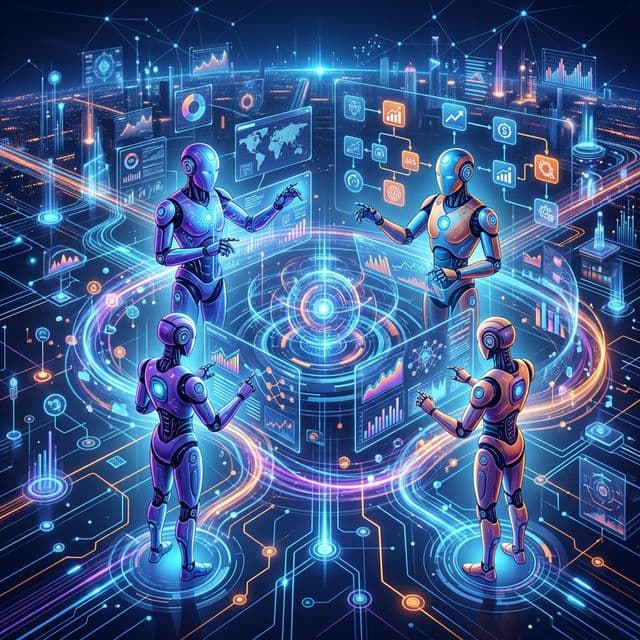
The B2B landscape is shifting. Static software is no longer enough; the future belongs to autonomous intelligence. AI agents are not just tools—they are an orchestration layer that connects your CRM, marketing stack, and operations into a single, high-speed engine.
By deploying autonomous AI agents, businesses can decouple labor from growth, allowing teams to focus on high-level strategy while agents handle the high-volume operational tasks. This is the foundation of the 'AI-First' enterprise.
Combined with intelligent workflows, these agents ensure that no lead is dropped and every customer interaction is hyper-personalized, 24/7.
The New Era of Autonomous Marketing
The landscape of B2B marketing is undergoing a seismic shift. For decades, businesses relied on manual lead generation, rigid email sequences, and high-touch human sales processes to navigate the complex B2B buying journey. However, the emergence of autonomous AI agents is fundamentally rewriting the rules of engagement. In 2026, the transition from simple automation to true agency marks the beginning of a new era in corporate growth.
AI agents are not merely sophisticated chatbots. They are goal-oriented, autonomous software entities capable of reasoning, decision-making, and executing complex workflows without constant human intervention. In the context of B2B marketing, these agents represent a quantum leap in efficiency and personalization. Unlike traditional 'if-then' logic, agentic AI uses large language models (LLMs) to understand intent, pivot strategies mid-conversation, and achieve objectives with a level of nuance previously reserved for senior account executives.
Hyper-Personalization at Scale: The End of the 'Spray and Pray' Method
One of the greatest challenges in B2B marketing has always been the trade-off between scale and personalization. While personalized outreach significantly higher conversion rates, it was traditionally labor-intensive. AI agents solve this by analyzing vast datasets—including company websites, LinkedIn profiles, financial reports, and news articles—to craft highly relevant, individualized messages for thousands of prospects simultaneously.
Imagine an agent that can read a prospect's recent quarterly earnings report, identify a specific challenge mentioned by the CEO, and automatically draft a proposal that explains exactly how your solution addresses that specific problem. This isn't just inserting a {first_name} tag; it's deep, strategic alignment. These agents can understand the specific pain points of a prospect's industry, reference recent company achievements, and align the product's value proposition with the prospect's current strategic goals. This level of detail, once reserved for the top 1% of accounts, is now accessible for the entire addressable market.
The End of the "MQL" and the Rise of the "Agent-Qualified Lead"
Traditionally, Marketing Qualified Leads (MQLs) were determined by broad behavioral signals, such as downloading a whitepaper or attending a webinar. However, many MQLs never converted to sales, creating friction between marketing and sales teams. AI agents are transforming this by conducting preliminary discovery and qualification conversations autonomously.
An AI agent can engage a website visitor in real-time, ask qualifying questions based on the company's Ideal Customer Profile (ICP), and determine the prospect's budget, authority, need, and timeline (BANT). But they go further: they can handle objections, provide technical specifications, and even perform live product demonstrations through dynamic interfaces. Only when a lead is truly "Sales Ready" does the agent hand it over to a human representative, ensuring that sales teams focus their energy on high-probability opportunities. This shift significantly reduces the cost per acquisition (CPA) and shortens the sales cycle by weeks.
24/7 Global Engagement and Omni-Channel Orchestration
B2B buying is increasingly global, yet human teams are constrained by time zones and office hours. AI agents provide a persistent, intelligent presence across all digital touchpoints. Whether a prospect in Singapore is researching solutions at 3 AM EST or a lead in London submits an inquiry on a Sunday, an AI agent can respond instantly, provide relevant technical documentation, and even schedule a demo for the following Monday.
Furthermore, these agents don't just sit on your website. They orchestrate outreach across email, LinkedIn, and even voice-AI systems. They maintain a consistent 'memory' of the prospect across these channels. Research shows that B2B buyers now require between 15 and 20 touchpoints before making a purchase decision; AI agents ensure that every one of those touchpoints is meaningful, coherent, and perfectly timed.
Continuous Learning: The Self-Optimizing Revenue Engine
Unlike traditional automation tools, AI agents learn from every interaction. They analyze which messaging resonates, which objections are most common, and which sequences lead to the highest conversion rates. They perform A/B testing on themselves in real-time. If an agent notices that prospects in the fintech sector respond better to data-driven case studies than to efficiency-focused whitepapers, it will automatically shift its strategy for all future fintech outreach.
This creates a self-optimizing marketing engine that improves daily. Marketing teams shift from "builders" of rigid workflows to "orchestrators" of intelligent agents. Their job becomes one of defining goals, providing high-quality training data, and setting the ethical and brand guardrails within which the agents operate.
Conclusion: Embracing the Agentic Future
The adoption of AI agents is no longer a luxury for B2B enterprises; it is becoming a competitive necessity. As prospects' expectations for immediate, intelligent, and personalized interaction continue to rise, businesses that leverage agentic AI will pull ahead of those relying on legacy processes. The future of B2B growth is autonomous, personalized, and driven by agents that never sleep, never stop learning, and never miss an opportunity.
About the Author
Vinit Rathee
Growth Marketing Director
Vinit specializes in architecting scalable growth through automation. He focuses on breaking the linear link between headcount and revenue for fast-growing startups.